I got this pillow with a blanket for Christmas. I ended up just taking it to my classroom since I didn't really know what to do with it. This week I decided I would re-cover it. So, I bought two white shirts from the dollar store. I cut out a 15x15 square. I was pleasantly surprised that my pillow was just a tad smaller than my quilting ruler, so I just cut out perfectly around it :) Out of the second shirt I cut off the bottom hem and tossed it. Then I cut a strip that was about 3 inches. Since it was off the bottom of the shirt it was like a tube. I cut it so that it made one long strip and then did a ruffle stitch down the middle.
I pinned it in the middle of one of my squares and then did a straight stitch down the middle.
I cut another strip about 1 1/2 inches, cut to make it one long strip. I pin it in the middle of the ruffle and sew around the perimeter.
Then I sew down the edges of the ruffle.
At this point I sew on buttons if I want them. then I pin right sides together and sew, leaving a hole large enough to turn right side out and stuff in the pillow.After the Pillow is in, I stitch it closed and ..... cute pillow!
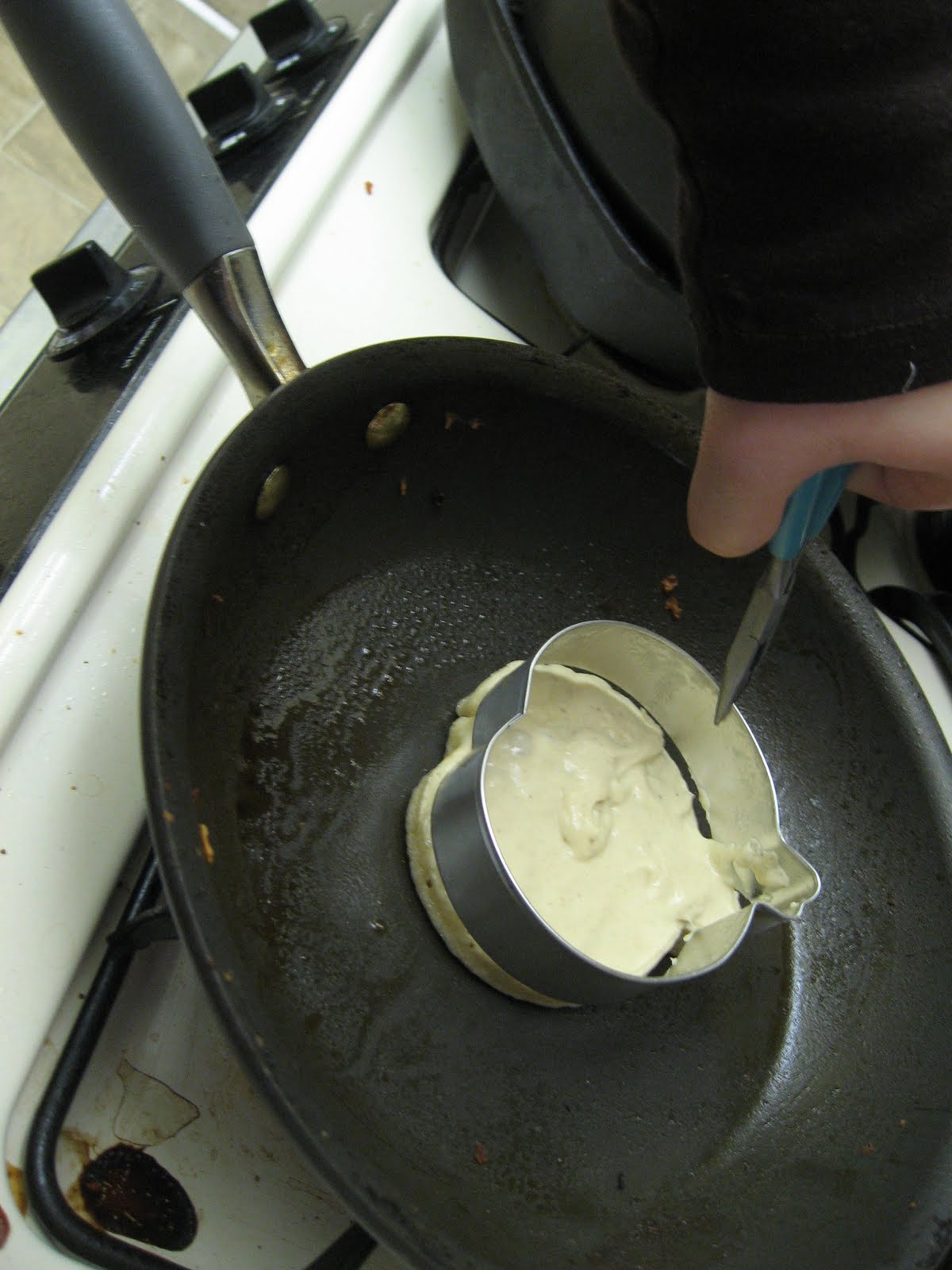
Don't fun shaped pancakes just make you smile! My mom gave me this fun little pancake shaper thing. You probably have already guessed that she gave it to me for Valentine's day... and now months later I finally decided to use it. As I was using it I thought to myself... this is just a cookie cutter with an easy way to pick it up! So that gave me an idea. Why not just use a cookie cutter and a pair of needle nose pliers? So I did. Now don't laugh... yes I know it is now spring and no longer fall... but I am a Kindergarten teacher and most of my cookie cutters are at work. So yes... I know it is a pumpkin, but hey, it will do the job. Be sure to spray it with non-stick spray before you begin, put it on the skillet and then pour in the batter. Remove the cookie cutter with the pliers before you flip the pancake and.... Bam!! fun shaped pancake without the need of an over priced silly device.
I have so many friends who are having babies! These are the burp cloths that I have been making... so if you are pregnant and my friend.... then stop reading :)
I bought a large pack of reusable diapers at Babies R Us. The re-usable diapers have a thicker part in the middle. I measured this part and then cut out a piece of fabric that was that size with about 1/4 inch extra all around. If it is a fabric that will run, then I would do a zig zag stitch around the entire perimiter before donig anything else. I then place the fabric on the diaper and tucked the edges in and pinned.
I did a straight stitch all the way around the outside, close to the edge. I then did another stitch about 1/4 inch in, simply because I thought it looked nicer. If you try this hopefully you sew straighter than I do :) Hey, I always say that if it isn't perfect, then people will know that I took the time to make it myself for them :)
I got fancy on some... and even added ruffles on one! I made some of them out of old T-shirts. Not only does it make the burp cloths cute, but it is also another way to be green through re-purposing!
I was at my friend's house the other day and she was talking about how she has so many plastic grocery bags and needed to find something to keep them all in. We were celebrating her birthday a few days later so I got busy :) I can now post the tutorial since I have delivered the gift.
First I cut out a piece of fabric. I want to guess it was about 14x16" (I didn't measure) Then I cut out another piece that would serve as my strap to hang it by. This was about 3x15" I took the large piece, but right sides together and did a zigzag stitch down one side to make a tube then I took each end, folded it down 1/4 inch and sewed a zigzag stitch. I folded it again about 1/2 an inch. This time I used a straight stitch since it would show on the pretty side and i left about 1" not sewn so that I could thread the elastic through. To thread the elastic through the tube I just made, I attached a large safety pin to one side and used it to guide the fabric in. It was actually really easy.
Once the elastic was out the other side, I pulled it until the opening to my trash bag holder was all gathered up to the size that I wanted. Then I sewed the two ends of the elastic together. Then finished closing up around the elastic. (do this on both sides)
Now for the strap. I put right sides together and did a zig zag stitch down. then I used a safety pin on one end to help feed the tube right side out.
Attach the straps and..... trash bag holders! the other one I did was a little longer and I think turned out a little better. But hey, it all depends on how big you want it :)
I don’t know about you but the high increase in those who have asthma and respiratory problems has me a little concerned.Living in a place that has poor air quality got me looking into ways to keep both me and my family the most healthy.Apparently there is this thing called “sick building syndrome”.New buildings are energy efficient, but apparently this is not good as far as air quality goes.So if you are in a drafty house, your air quality is probably better than in a new home or building.Imagine that!!!One way to help combat this is with plants in your home.
Although all plants that are indoors are beneficial, NASA and other research has found that some are better at scrubbing chemicals out of the air and producing oxygen than others.Apparently soil and roots of these plants are also important as the chemicals act as a food for the plant so the more exposure the soil has to the air the better.(make sure low leaves are trimmed to increase soil/air exposure)
If you are starting with just a few plants, here is a good place to start.This is according to the website: The Secrets to Longevity (website at bottom)
Top three oxygen producing plants:
1.Sprouts: Grow your own sprouts for food and oxygen! (especially sweet pea sprouts, buckwheat sprouts and sunflower sprouts) You will also get nutrients and good things when you eat them!
2.Snake Plant a.k.a. Mother-In-Law’s Tongue: This one is really cool!It takes Carbon Dioxide and converts it to Oxygen at night which makes it great for your bedroom.Get this:all you need is 6-8 plants that are waist high per person if you needed to survive in a sealed room!Well that and the Areca Palm so that you could breath during the day.The snake plant also removes formaldehyde from the air.Not to mention that they look cool J
3.Areca Palm: This plant removes Xylene and Toluene from the air.It also turns a lot of Carbon Dioxide into Oxygen during the day. Having four (shoulder high plants) of these per person in your house can produce enough oxygen to survive on during the day! They need to have dust and grime wiped off of their leaves once a week, or more often if the air quality is really, really bad where you live.
Top three air cleaning plants:
1.Madagascar Dragon Tree a.k.a. Red Edged Dracaena: This is a low maintenance house plant and is best at removing benzene, formaldehyde, xylene and toluene from the air. It cannot tolerate direct sunlight yet it does well in fairly well indirectly lit areas. It is more susceptible to becoming damaged from over watering than infrequent watering. (perfect for me)
2.Warneck Dracaena: A very popular indoor plant.Removes benzene, trichloroethylene, xylene and toluene from the air.
3.Peace Lily: This species (of which there are a variety of sub-species grows best in the shade .Only water it about once a week and make sure the water is chlorine free. Never let the soil go completely dry. This house plant removes benzene, formaldehyde, acetone, amonia and trichloroethylene from the air. It also periodically flowers!
Want to know more?
Here are NASA’s findings (with a few things I have found):
The NASA studies recommend that you use 15-18 plants in 6-8 inch pots to improve the air quality in a house 1800d sq. ft. The better the plants grow, the better they are cleaning your air.Here are the plants that NASA recommends (I added some other information that I discovered while researching):
Hedera helix English ivy
This one can be poisonous to animals.Someone online said that her vet suggested spraying the plant with water and then sprinkling ginger on it.The animals stay away from plants they previously enjoyed chewing.
Toxic if eaten by children as well
Prefers well drained soil
Chlorophytum comosum spider plant
One of the top three plants for removing formaldehyde
Prefers well drained soil
Epipiremnum aureum golden pothos
Spathiphyllum `Mauna Loa' peace lily
Lilys are also toxic to cats, sometimes even from just rubbing against them so be careful.
NASA also noted that some plants are better than others in treating certain chemicals.
For example, English ivy, gerbera daisies, pot mums, peace lily, bamboo palm, and Mother-in-law's Tongue were found to be the best plants for treating air contaminated with Benzene.
The peace lily, gerbera daisy, and bamboo palm were very effective in treating Trichloroethylene.
Additionally, NASA found that the bamboo palm, Mother-in-law's tongue, dracaena warneckei, peace lily, dracaena marginata, golden pathos, and green spider plant worked well for filtering Formaldehyde.
Chemicals Used in the NASA study:
Trichloroethylene (TCE) is a commercial product found in a wide variety of industrial uses. Over 90 percent of the TCE produced is used in the metal degreasing and dry cleaning industries. In addition, it is used in printing inks, paints, lacquers, varnishes, and adhesives. In 1975 the National Cancer Institute reported that an unusually high incidence of hepatocellular carcinomas was observed in mice given TCE by gastric intubation and now considers this chemical a potent liver carcinogen.
Benzene is a very commonly used solvent and is also present in many common items including gasoline, inks, oils, paints, plastics, and rubber. In addition it is used in the manufacture of detergents, explosives, pharmaceuticals, and dyes.
Benzene has long been known to irritate the skin and eyes. In addition, it has been shown to be mutagenic to bacterial cell culture and has shown embryotoxic activity and carcinogenicity in some tests. Evidence also exists that benzene may be a contributing factor in chromosomal aberrations and leukemia in humans. Repeated skin contact with benzene will cause drying, inflammation, blistering and dermatitis.
Acute inhalation of high levels of benzene has been reported to cause dizziness, weakness, euphoria, headache, nausea, blurred vision, respiratory diseases, tremors, irregular heartbeat, liver and kidney damage, paralysis and unconsciousness. In anima tests inhalation of benzene led to cataract formation and diseases of the blood and lymphatic systems. Chronic exposure to even relatively low levels causes headaches, loss of appetite, drowsiness, nervousness, psychological disturbances and diseases of the blood system, including anemia and bone marrow diseases.
Formaldehyde is a ubiquitous chemical found in virtually all indoor environments. The major sources which have been reported and publicized include urea-formaldehyde foam insulation (UFFI) and particle board or pressed wood products used in manufacturing of the office furniture bought today. It is used in consumer paper products which have been treated with UF resins, including grocery bags, waxed papers, facial tissues and paper towels. Many common household cleaning agents contain formaldehyde. UF resins are used as stiffeners, wrinkle resisters, water repellents, fire retardants and adhesive binders in floor coverings, carpet backings and permanent-press clothes. Other sources of formaldehyde include heating and cooking fuels like natural gas, kerosene, and cigarette smoke.
Formaldehyde irritates the mucous membranes of the eyes, nose and throat. It is also a highly reactive chemical which combines with protein and can cause allergic contact dermatitis. The most widely reported symptoms from exposure to high levels of this chemical include irritation of the eyes and headaches. Until recently, the most serious of the diseases attributed to formaldehyde exposure was asthma. However, the Environmental Protection Agency (EPA) has recently conducted research which has caused formaldehyde to be strongly suspected of causing a rare type of throat cancer in long-term occupants of mobile homes.
For an average home of under 2,000 square feet, the study recommends using at least fifteen samples of a good variety of these common houseplants to help improve air quality. They also recommend that the plants be grown in six inch containers or larger.
Here are some tips for keeping your plants healthy and thus, keeping you more healthy according to the longevity website:
·Avoid placing them in corners with stagnant or no air flow or by radiators that produce excessive heat which can damage them.
·Indirect sunlight is best for the air cleaning plants mentioned (because they are mostly shade growing jungle plants) but other types of flowering plants will usually need some direct sun.
·Take them outdoors at least every couple of months for a day or two.
·Clean or dust their leaves about once a week, more often in a dirty city.
·Over-watering is more harmful than under-watering, allow the soil to get fairly dry between waterings (except for the peace lily and your sprouts).
·Mist the leaves since these are jungle plants that like humidity.
·Use an organic fertilizer on occasion such as diluted ocean water, seaweed extract and/or pour the soak water into the soil of your plants left over after germinating your nuts, seeds, grains, legumes and sprouting seeds.
I find this kind of thing very interesting!It makes me want to go and buy more plants… but space is always my downfall.Hopefully I will have a house in a few months and I will be able to have more plants.I listed the websites where I got my information if you want to do some more research or read the full articles.
Here is a list of resources for more information:
PDF files of the NASA studies related to plants and air quality:
So I have been inspired by Disney at Ruffles and stuff to re-fashion cloths I don't wear into something that I might wear. I had this tank top that was way too short and boring.
this is what I started with this boring too short tank and pillow case: I cut up the pillowcase and made tons of ruffles
So I went a little bit ruffle crazy. I learned how to make them about a week ago and I think they may be my new obsession. I am not sure how I like the bottom, but hey, it is better than what I started with so I will take that as a win!
I was at a craft store and fell in love with this string of beads. They were my favorite color (green of course) and I couldn't help but buy them. I brought them home and turned this strand of beads into a necklace. Here is how I did it:
1. Cut a length of tiger tail wire a little bit longer than you want it. 2. String a crimping bead and a clasp onto the end of the wire 3. loop the wire around the clasp and back through the crimping bead. Leave about 1 inch of a tail. Use needle nose pliers and squish the crimping bead firmly. 4. Start stringing the beads making sure you string the beads through the wire and the tail as well so that it doesn't show.
5. When you are done stringing the beads, end with another crimping bead and the other end of the clasp. Trim the tail so that there is about 1 in. of room.6. Loop around the end clasp and back through the crimping bead and through the beads so that the tail is hidden within. Make sure that the tail doesn't poke out between any beads.
7. Use the needle nose pliers and crimp the bead (squish it) firmly.
I did a second row the same way as the first... and enjoy!!!

 I cut out a 15x15 square. I was pleasantly surprised that my pillow was just a tad smaller than my quilting ruler, so I just cut out perfectly around it :)

 I cut another strip about 1 1/2 inches, cut to make it one long strip. I pin it in the middle of the ruffle and sew around the perimeter.


 After the Pillow is in, I stitch it closed and ..... cute pillow!